Deck Feels Bouncy or Wobbly Underfoot? What Your Framing Is Trying to Tell You
August 19, 2026
How Georgia's Climate Creates Unique Demands on Porch Windows
Trusted Craftsmanship Behind Every Georgia Porch Window System
Georgia's climate demands materials built for real performance, not just visual appeal. Glass delivers unmatched longevity and optical clarity, with the tradeoff of weight and brittleness under direct impact. Vinyl offers moisture resistance and flexibility at a lighter weight, but requires quality UV inhibitors and properly engineered tracks to hold up under sustained heat. Acrylic brings impact resistance and light weight, but its susceptibility to scratching and UV yellowing limits its service life in full-sun Georgia exposures. The right choice depends on your porch orientation, how you use the space, and how long you intend to hold the investment.
For homeowners in Cumming, Georgia, that decision carries real weight. JT Deck And Porches has been building and enclosing porches in the North Georgia region for 38 years. We have watched how materials behave through Georgia summers, storm seasons, and the freeze-thaw cycles that catch homeowners off guard in late winter. Our recommendations are built on that accumulated field knowledge, not on product catalogs.
When we specify a
porch window system, we evaluate the structural load capacity of the existing deck, the orientation and sun exposure of the enclosure, the homeowner's intended use, and the long-term maintenance picture. We do not upsell material upgrades for their own sake. We recommend what we have seen hold up, and we stand behind that recommendation with 38
years of completed projects across Cumming and the surrounding communities.
The Heat and Humidity Combination
Georgia sits in a humid subtropical climate zone. Summers are long, hot, and saturated with moisture. Average summer temperatures in the Cumming and North Georgia region regularly exceed 90 degrees Fahrenheit, and relative humidity frequently climbs past 80 percent. That combination accelerates material degradation in ways that drier climates simply do not produce.
When a window panel absorbs heat, it expands. When temperatures drop overnight, it contracts. Over hundreds of cycles per year, this thermal movement stresses seals, frames, and the panel material itself. Materials that cannot flex with that movement will crack, warp, or delaminate. Georgia homeowners need window systems engineered to handle this range, not just marketed to handle it.
UV Radiation and Seasonal Storms
Beyond heat, Georgia receives intense UV radiation throughout a long outdoor season. UV exposure causes photodegradation in many polymers, which is the process by which molecular bonds break down under ultraviolet light. The visible result is yellowing, hazing, or brittleness in plastics and certain coatings. Storm season adds a separate mechanical challenge. Hail, wind-driven debris, and heavy rain test impact resistance and water sealing. A porch window system that fails under storm pressure creates interior water damage, frame rot, and mold risk inside the enclosure.
Acrylic scratches more easily than glass. Surface scratches diffuse light and reduce clarity over time, particularly in panels cleaned with abrasive products or rough materials. In a porch environment where panels are handled seasonally, stored, and reinstalled, scratch accumulation is a real concern.
More significantly for Georgia applications, acrylic yellows under prolonged UV exposure. Even UV-stabilized acrylic grades will show measurable yellowing over a decade of Georgia sun. Untreated or economy-grade acrylic yellows faster. Once yellowing begins, it cannot be reversed without panel replacement. For a permanent enclosure, this is a long-term durability liability that glass does not carry.
You walk out to grill on a Saturday evening and notice it again. That little give in the boards near the steps, the slight sway when a few people gather by the rail, the flex you feel through your feet that wasn't there a couple summers ago. Most homeowners chalk it up to an old deck just being an old deck. Sometimes that's true. More often, bounce and wobble are the deck's way of telling you something specific is happening underneath the boards, in the framing you never see.
A deck that moves under normal weight isn't performing the way a well-built structure should. It doesn't mean the whole thing is unsafe today, but it does mean something in the joists, blocking, ledger, or support posts has shifted, loosened, or started to fail. Catching that early is the difference between a focused repair and a full rebuild a few years down the road.
Quick Answer: A bouncy or wobbly deck usually comes down to undersized or widely spaced joists, missing mid-span blocking, a loosening ledger connection, or posts and footings that have shifted. In North Georgia's clay soil and humid climate, moisture-driven wood movement and fastener corrosion speed up all four. A framing inspection identifies which one (or combination) is causing the movement.
What's Actually Happening Under Your Feet
Every deck surface is only as rigid as the framing holding it up. The boards you walk on are just the finish layer. Beneath them is a grid of joists resting on beams, which sit on posts, which transfer weight down to footings in the ground. When that grid flexes more than it should, you feel it as bounce. When the whole structure sways side to side, you feel it as wobble. Two different sensations. Same root cause: something underneath has given way, even slightly.
Joist Spacing and Sizing
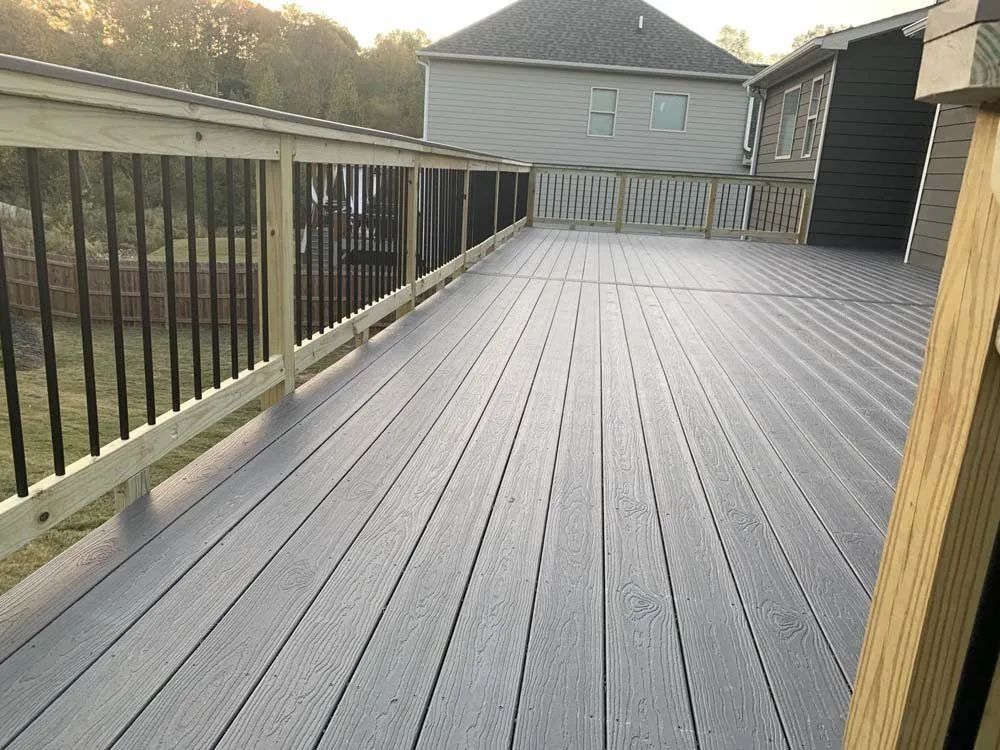
Joists that are spaced too far apart, or sized too small for the span they're covering, will deflect under load even when everything else is sound. Residential deck framing typically calls for joists no more than 16 inches on center, and often tighter for a stiffer feel or for diagonal board patterns. If your deck was built with joists spaced wider than that, or if a previous owner extended the deck without matching the original joist size, you'll feel it every time someone walks across that section. This is one of the more common issues we run into on older decks around Cumming and Alpharetta, where additions were tacked onto an original frame without reinforcing the span underneath.
Missing or Failed Blocking
Blocking is the short, perpendicular lumber installed between joists at intervals along the span. It keeps individual joists from twisting or leaning independently, and it ties the whole frame together so weight gets distributed instead of concentrated on one board. A lot of older decks, especially ones built as weekend DIY projects, skip blocking entirely or install it too sparingly. Without it, each joist behaves almost like its own separate beam, which is exactly why you feel a soft or springy spot in one specific area rather than uniform give across the whole deck.
The Ledger Connection Nobody Sees
If your deck attaches to the house, the ledger board is the single most important connection in the entire structure. It's also the one homeowners never think about, since it's hidden behind the rim joist. But it's carrying a huge share of the deck's weight back into the house framing, and when it loosens, whether from failed fasteners, moisture behind the board, or wood that's decayed where it meets the house, you get a very particular kind of movement. The deck sways slightly away from the house under weight, sometimes with a visible gap opening and closing at the connection point, and the bounce tends to be most noticeable near where the deck meets the wall rather than out at the far edge.
Tip: Stand at the point where your deck meets the house and have someone walk across the far end while you watch that connection. If you see any gap open up, even a small one, that's your ledger telling you it needs attention before it tells you in a more dramatic way.
How Humidity and Wooded Lots Compound the Problem
North Georgia's climate is tough on deck framing in ways that aren't always obvious from the surface. The humidity that settles over Cumming, Suwanee, and the lake communities around Buford keeps framing lumber in a near-constant cycle of absorbing and releasing moisture. Wood swells when it's damp and shrinks as it dries, and that repeated movement loosens fasteners over time, even galvanized ones rated for exterior use. Add in wooded lots with heavy shade, where framing underneath the deck rarely gets a chance to dry out fully between rains, and you've got conditions that accelerate everything from joist hanger corrosion to slow rot at connection points.
Pollen season adds another layer homeowners rarely connect to structural issues. Thick pollen and organic debris settle on top of joists and around blocking, trapping moisture against the wood far longer than open air would allow. That's part of why the underside of a deck in a wooded yard often shows wear well before the visible surface does.
Warning: Don't mistake surface graying or a few loose deck boards for the full picture. Movement you feel underfoot, especially a spring or sway near the ledger or a support post, can mean the framing itself has been compromised. Walking on a deck with a significantly weakened structural connection carries real risk, and it's not something to wait out through another season.
Posts, Beams, and Footings
Bounce that shows up more like a global wobble, rather than a soft spot in one area, often traces back to the support structure rather than the joists themselves. Posts that were never properly anchored to their footings, footings that have shifted in Georgia's clay-heavy soil, or beams undersized for the load they're carrying will all produce a sway you can feel through the whole platform, especially near the outer edge farthest from the house. Clay soil swells and contracts hard with moisture changes. A deck that felt rock solid the day it was built can develop a slight lean or wobble years later without any change in how it's used, just from the ground moving underneath it.
When Sistering Solves It, and When It's Time to Rebuild
Not every framing issue means starting over. If the joists themselves are structurally sound but under-spanned or missing blocking, sistering, which means fastening a new joist alongside the existing one to add strength, is often enough to eliminate bounce without touching the deck surface. The same goes for reinforcing a ledger connection with additional structural fasteners or adding blocking that was never installed in the first place. These are targeted fixes that address the actual cause instead of masking the symptom.
A rebuild becomes the right call when the underlying wood has decayed, when several framing members show the same failure at once, or when the original design simply wasn't built for the span and load it's carrying today. There's no shortcut around a hands-on inspection. It's the only reliable way to know if you're facing a focused repair or a more involved project.
Frequently Asked Questions
Why does my deck feel bouncier in some spots than others instead of everywhere at once?
Localized bounce usually indicates a specific framing problem, such as an undersized joist, missing blocking, or loose fastener. Widespread movement more often involves beams, posts, footings, or support connections underneath.
Is a bouncy deck automatically unsafe to use?
Not necessarily, but noticeable bounce deserves attention. Minor flexibility can occur naturally in wood framing, while increasing spring, ledger movement, or significant sway may indicate structural components requiring inspection and repair.
Can I tell if the problem is the ledger versus the joists just by walking on the deck?
You can often narrow it down. Movement near the house may indicate ledger problems, while bounce near outer areas typically suggests joist spacing, sizing, blocking, or other framing concerns below.
Does the direction my deck boards run affect how much bounce I feel?
Yes. Diagonal decking often requires closer joist spacing than straight boards. When existing framing is spaced too widely for the board direction, the deck may feel noticeably springier under normal foot traffic.
How often should framing be checked on an older deck in North Georgia?
Check older deck framing annually, preferably before heavy seasonal use. North Georgia humidity, moisture, shaded conditions, and clay soil movement can gradually affect lumber, fasteners, posts, footings, and structural connections.
Will adding blocking after the fact fix a bounce problem, or does it need to be there from the start?
Blocking can be added later and may significantly improve deck stiffness. However, undersized or over-spanned joists may still require sistering, reinforcement, or replacement to fully correct persistent movement under normal loads.
Stronger Framing Keeps Your Deck Feeling Solid
A deck that starts bouncing or shifting underfoot is often showing early signs that its framing needs attention. Joists, blocking, ledger connections, posts, beams, and footings all work together, so weakness in one area can gradually affect the entire structure. In Cumming, GA, changing moisture levels, humid conditions, and clay soil can place additional stress on these components. Understanding where the movement begins makes it easier to determine whether reinforcement or more extensive framing work is appropriate.
With 38+ years of experience, JT Deck And Porches
understands how
deck
framing changes as materials age and local conditions take their toll. Some movement can be corrected by adding blocking, sistering joists, strengthening connections, or stabilizing supports, while widespread deterioration may point toward rebuilding. What matters most is addressing the structural cause rather than simply covering up the noticeable symptoms. Properly supported framing restores a firmer feel underfoot and helps the deck remain dependable through changing seasons and everyday use.