Deck Railings Loose or Wobbly? Why It's a Safety Issue Worth Acting On
October 31, 2026
How Georgia's Climate Creates Unique Demands on Porch Windows
Trusted Craftsmanship Behind Every Georgia Porch Window System
Georgia's climate demands materials built for real performance, not just visual appeal. Glass delivers unmatched longevity and optical clarity, with the tradeoff of weight and brittleness under direct impact. Vinyl offers moisture resistance and flexibility at a lighter weight, but requires quality UV inhibitors and properly engineered tracks to hold up under sustained heat. Acrylic brings impact resistance and light weight, but its susceptibility to scratching and UV yellowing limits its service life in full-sun Georgia exposures. The right choice depends on your porch orientation, how you use the space, and how long you intend to hold the investment.
For homeowners in Cumming, Georgia, that decision carries real weight. JT Deck And Porches has been building and enclosing porches in the North Georgia region for 38 years. We have watched how materials behave through Georgia summers, storm seasons, and the freeze-thaw cycles that catch homeowners off guard in late winter. Our recommendations are built on that accumulated field knowledge, not on product catalogs.
When we specify a
porch window system, we evaluate the structural load capacity of the existing deck, the orientation and sun exposure of the enclosure, the homeowner's intended use, and the long-term maintenance picture. We do not upsell material upgrades for their own sake. We recommend what we have seen hold up, and we stand behind that recommendation with 38
years of completed projects across Cumming and the surrounding communities.
The Heat and Humidity Combination
Georgia sits in a humid subtropical climate zone. Summers are long, hot, and saturated with moisture. Average summer temperatures in the Cumming and North Georgia region regularly exceed 90 degrees Fahrenheit, and relative humidity frequently climbs past 80 percent. That combination accelerates material degradation in ways that drier climates simply do not produce.
When a window panel absorbs heat, it expands. When temperatures drop overnight, it contracts. Over hundreds of cycles per year, this thermal movement stresses seals, frames, and the panel material itself. Materials that cannot flex with that movement will crack, warp, or delaminate. Georgia homeowners need window systems engineered to handle this range, not just marketed to handle it.
UV Radiation and Seasonal Storms
Beyond heat, Georgia receives intense UV radiation throughout a long outdoor season. UV exposure causes photodegradation in many polymers, which is the process by which molecular bonds break down under ultraviolet light. The visible result is yellowing, hazing, or brittleness in plastics and certain coatings. Storm season adds a separate mechanical challenge. Hail, wind-driven debris, and heavy rain test impact resistance and water sealing. A porch window system that fails under storm pressure creates interior water damage, frame rot, and mold risk inside the enclosure.
Acrylic scratches more easily than glass. Surface scratches diffuse light and reduce clarity over time, particularly in panels cleaned with abrasive products or rough materials. In a porch environment where panels are handled seasonally, stored, and reinstalled, scratch accumulation is a real concern.
More significantly for Georgia applications, acrylic yellows under prolonged UV exposure. Even UV-stabilized acrylic grades will show measurable yellowing over a decade of Georgia sun. Untreated or economy-grade acrylic yellows faster. Once yellowing begins, it cannot be reversed without panel replacement. For a permanent enclosure, this is a long-term durability liability that glass does not carry.
Not every framing issue means starting over. If the joists themselves are structurally sound but under-spanned or missing blocking, sistering, which means fastening a new joist alongside the existing one to add strength, is often enough to eliminate bounce without touching the deck surface. The same goes for reinforcing a ledger connection with additional structural fasteners or adding blocking that was never installed in the first place. These are targeted fixes that address the actual cause instead of masking the symptom.
A rebuild becomes the right call when the underlying wood has decayed, when several framing members show the same failure at once, or when the original design simply wasn't built for the span and load it's carrying today. There's no shortcut around a hands-on inspection. It's the only reliable way to know if you're facing a focused repair or a more involved project.
Quick Answer: A loose or wobbly deck railing almost always means the connection between the post and the deck frame has weakened, and that connection is what stops a person from falling when they lean or stumble. Common causes are bolts that have backed out as treated lumber dried, posts that were only nailed or lagged to the edge of the deck, notched posts that lost strength, rot where the post meets the framing, and missing blocking behind the post. A railing that moves when you push on it is not safe to lean on, so treat it as a repair that should happen soon rather than something to revisit next season.
You lean against the rail at the end of a long day, drink in hand, looking out at the trees, and the whole section gives a little. Maybe it is only half an inch. Maybe it is more. You push on it with your hip, and it moves again. You tell yourself it has always been a little loose and nobody has ever fallen, and you go back to the view.
That small bit of movement is worth pausing on. A railing has one job, and it does that job only when it stays put under a sudden load: a child running into it, a guest tripping on the top step, a grown adult catching their balance after a misstep. A rail that wobbles when you push it gently is not going to hold when someone throws their weight against it.
After 38 years of building and repairing decks and porches around Cumming and the north metro Atlanta area, we have seen how this usually goes. The railing rarely fails on a quiet afternoon. It fails at a party, a cookout, or a moment when someone is moving fast. This article walks through why railings loosen, what you can check from the top of the deck, and how to tell a quick fix from a structural repair.
Why a Railing Is Really a Structural Part of the Deck
It is easy to think of a railing as trim, something that finishes the look of the deck. In practice it is a structure of its own. Each post acts like a lever. The taller the post, the more a small push at the top turns into a large pulling force at the base, where the post attaches to the deck frame. A person leaning on a 36 inch rail applies far more force to those connection points than the same person standing on the deck surface applies to a single board.
That is why the attachment matters more than the post, the rail, or the balusters. A beautiful, heavy post bolted to a weak spot is still a weak railing. The pieces you can see are rarely the problem. The problem is almost always in the few inches where the post meets the rim joist or the framing below it.
The Most Common Reasons Posts Work Loose
Once you know where to look, loose railings tend to follow a handful of patterns.
Bolts That Have Backed Out
Treated lumber is often installed wet and shrinks as it dries over the first few seasons. In North Georgia, seasonal humidity changes keep wood expanding and contracting, gradually loosening nuts and creating movement at railing connections.
Lag Screws Or Nails Doing A Job They Were Not Meant To Do
Lag screws driven into joist sides or nails driven into end grain may not withstand repeated sideways pressure. Tall railing posts increase that force, making poorly secured connections increasingly loose after regular use.
Notched Posts
Older decks sometimes have notched posts fitted against the outside frame. Removing wood at this high-stress connection weakens the post and increases splitting risks, even when cracks near the bottom remain hidden from view.
Missing Blocking Behind The Post
A post attached to a single outside joist without additional blocking lacks solid support behind the connection. The joist flexes under pressure, allowing the railing to wobble. Proper blocking strengthens the attachment and reduces movement.
Rot At The Base
Water trapped where a post meets the framing encourages rot, especially on shaded decks covered with leaves and pollen. As the wood softens around bolts, fasteners lose their grip, and tightening alone cannot restore strength.
Tip: Push on each post at the top, one at a time, with firm pressure in and out and side to side. A solid post moves almost not at all. Any post that shifts at the base, clicks, or feels like it is pivoting around a single point deserves a closer look from underneath the deck.
What You Can Check From the Top and Underneath
You do not need tools to get a good sense of what is happening. Walk the full length of the railing and push on every post, not just the one that feels worst. Then check the following.
Look at the base of each post for cracks that run with the grain, especially near the bolts. Check whether the post is notched or cut away where it meets the deck frame. Look for dark staining, soft spots, or a spongy feel when you press a thumbnail into the wood, all of which point to moisture damage. If you can get underneath the deck, look at how each post connects. You want to see bolts that pass all the way through, with washers and nuts, and solid framing on both sides of the connection rather than a single thin board.
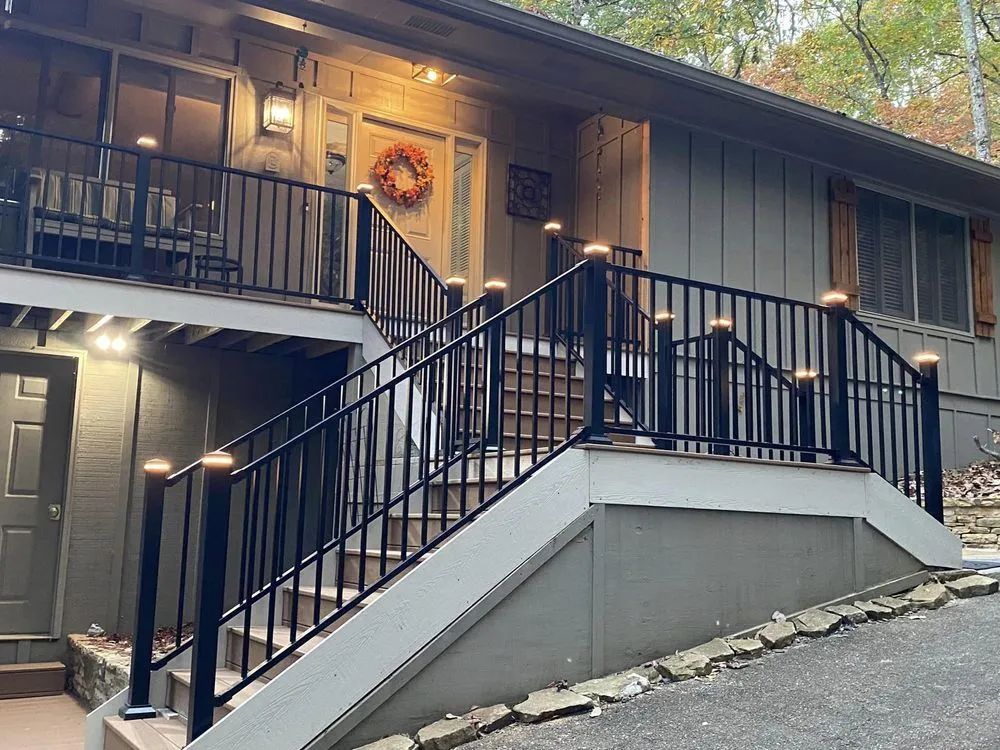
Pay attention to stair railings as well. They carry the same loads at an angle, and a stumble on stairs puts more force on the rail than a stumble on flat decking. Stair posts and the handrails that connect them are often the first sections to loosen, because the framing underneath is harder to build solid and tends to take more abuse.
Why Tightening a Nut Is Not Always a Fix
Sometimes a snug nut is all that was needed. If the posts are solid, the framing is sound, and the only issue is a bolt that backed out as the lumber dried, tightening it can restore the connection. That is a reasonable quick check and worth doing every spring and fall.
But if the nut keeps coming loose, or if tightening makes the post move around the bolt rather than hold still, the wood around the hole has been compromised. Over tightening can also crush the wood fibers and make the connection worse over time. When a connection will not stay tight, the real fix is almost never more tightening. It is replacing the part that has failed, whether that is the post, the blocking, the joist, or all three.
Warning: Do not rely on a screw, a bracket, or a few deck screws added to the outside of a loose post as a permanent solution. Fasteners added to a failing connection often hide the movement without restoring the strength, which can make a dangerous railing feel safe until the moment it fails.
When a Loose Railing Points to a Bigger Problem
A wobbly railing is sometimes the first sign of trouble in the deck itself. The rim joist that the posts attach to is part of the main frame. If it has rotted, split, or pulled away from the house, the railing is only showing you a symptom of something deeper. The same goes for posts that are attached to joists whose ends have softened from water sitting against them.
On wooded lots in Alpharetta, Roswell, and Johns Creek, shade and leaf litter keep framing damp far longer than on an open lot, and that moisture is a steady, slow cause of hidden damage. A deck can look sound on top and still have framing near the railing that is no longer reliable. That is part of why we recommend a hands on look at the structure whenever a railing section moves, rather than treating the rail as an isolated problem.
If the deck surface also feels bouncy, if boards near the rail are soft, or if you can see gaps opening between the deck and the house wall, the repair needs to cover more than the railing.
What a Proper Railing Repair Looks Like
A good repair starts by finding out why the connection failed, then correcting that cause so the new work lasts. In practice, that usually means some combination of the following:
Replacing posts that are notched, cracked, or rotted with full size posts that are not cut away at the connection. Adding solid blocking behind each post so the bolts are pulling against real framing instead of a single thin board. Using through bolts with washers and nuts, sized and placed so they stay in the strong center of the post instead of near the edge. Using hardware rated for contact with treated lumber, since the chemicals in modern treated wood corrode unprotected steel over time. And rechecking the balusters and top rail, because a post that has been loose for years often leaves the rest of the railing out of square or stressed.
The baluster spacing matters too. Gaps that are too wide can let a small child slip through, and older railings sometimes have gaps that have widened as boards shrank or shifted. A repair is a good time to bring the whole railing back to a safe, consistent spacing.
On a porch the same principles apply, with one extra twist. Porch railings often tie into columns or into the porch roof structure, so a loose rail there can mean the connection to a column needs attention as well.
Matching the Repair to the Material
Wood, composite, and metal railings loosen for slightly different reasons. Wood railings tend to loosen because of moisture and shrinkage. Composite railing systems rely on specific brackets and posts designed for the system, and a loose composite rail usually points to the sleeve over the post or the base mount not being anchored well to solid framing. Metal railings, such as aluminum, usually hold their shape well, but they depend on their base plates being bolted to something strong, so a loose metal rail often comes back to the framing beneath it.
In every case the rail is only as good as what it is attached to. That is why the repair focuses on the connection and the framing first, and the style and finish second.
Frequently Asked Questions
How much should a deck railing move before I worry?
A railing should feel solid when you push on it. Some flex in the top rail between posts is normal, but the posts should barely move. Any shift at the base needs attention.
Can I fix a loose deck railing myself?
Tightening a loose nut or replacing a missing bolt is reasonable if the surrounding wood is solid. A cracked post, soft base, notched post, or a connection that keeps loosening is better left to a professional.
Why does my railing feel looser after winter?
Wood swells with moisture and shrinks as it dries. Repeated damp and dry spells work on bolts and connections, so a joint that felt snug in humid weather can loosen once the air turns dry.
Is a loose stair railing more urgent than a loose deck railing?
Both matter, but stairs deserve extra attention. People grab the rail instinctively when they slip on steps, and stair railings take sudden, angled loads. A loose stair rail should be addressed as soon as noticed.
Do balusters need to be replaced if the posts are the problem?
Not always. Solid, properly spaced balusters can usually be reused once the posts are secured. If they are cracked, loose in the rails, or spaced too wide, replacing them together avoids a second visit.
How often should I inspect my deck railings?
Twice a year is a good habit, once in spring before outdoor season and once in fall. After a major storm or heavy rain, a quick push test on each post catches problems early.
Act on a Wobbly Rail Early
If your railing moves when you lean on it, treat that movement as a warning rather than a quirk you have lived with. A rail does its one job only when the connection to the frame stays solid under a sudden load, and loose posts, notched connections, and soft framing only worsen with each passing season. Walk the line, push every post, and look underneath where you can. The few inches where the post meets the frame are where safety is won or lost.
Catching the problem early is almost always the difference between a quick repair and a rebuilt section. JT Deck And Porches
has worked on railings throughout Cumming, GA for 38+ years, and that long run through the region’s damp, shaded lots is what tells a backed out bolt from failing framing behind it. Check the connections each spring and fall, correct the cause rather than the symptom, and your deck stays a place people can lean on without a second thought during the next gathering.